It is two years since I took over the Cottageology group, in September 2023, from its founder Orla Fitzmaurice, who set up the website in 2009 and the facebook group in 2017. Cottageology is, in many ways, a great name for the group, as shorthand for “the science, or study of, cottages”. Orla put many years of creative voluntary work into the group from her perspective as an architectural draughtsperson, and as someone who lived in one of Dublin’s many planned groups of worker’s cottages – she is fascinated by their history. Her life had moved on, whereas I was moving towards retirement, so I had a little bit of time to work on the problem. The cover picture of the group is Orla’s house, and we’ve also kept her website in archive form.
Immediately, as the possessor of a “BBC” English accent, I ran slap-bang into predictable problems around the word “cottage”. It was deprecated by Dr Barry O’Reilly, who has written extensively about Irish vernacular houses. Other folklorists and local historians also disapproved, most of them quoting Kevin Danaher. If you’ve never read any of Danaher’s work, start with his Wikipedia entry. It will be worth every minute of your time!
Dr Clíona O’Carroll, lecturer in Folkore and ethnology at University College Cork, puts it like this:
“I insist on the use of ‘house’ by my students because of the heavy social meaning given to the word ‘cottage’ as well as the technical difference between the two terms traditionally. You’ll very very rarely see ‘cottage’ used within the tradition, with the exception of Irish-speaking areas when and where people first learned Engish abroad. This is the slide I use:
Small Dwellings act 1883:
Enabled local authorities to build almost 50,000 cottages for landless labourers by 1921
‘This act not only brought new types of small houses into the countryside, but also brought a new word into the vocabulary of the country people, for, in rural Ireland, the word “cottage” is used only for these.’
‘A thatched house, no matter how small, is never called a cottage.’
Ó Danachair, Caoimhín (1962) ‘Change in the Irish Landscape’, in Ulster Folklife, Vol 8.
From that point on, I pull them up in a comically-exaggerated way if they use the word ‘cottage’, except to refer to a house built by an employer or an authority for someone who usually doesn’t have the means to build for themselves. They taunt me years afterwards with the word “cottage” when they meet me on the street.”
So it is a word which implies you came from a place of poverty and exclusion – you weren’t likely to be marrying the farmer’s daughter. Dr Claudia Kinmonth, as highlighted by Robert O’Byrne in the Irish Aesthete, notes: “‘By the nineteenth century in Ireland, the term cottage was used disparagingly, mainly by visiting English. The term is not used in this text as it was considered derogatory by country people, who called their homes houses, regardless of size and status.”
Irish Country Furniture and Furnishings, 1700-2000
Or more informally: “It’s mostly used by the tourist board /renters / and for people’s second house, the holiday home. Nobody I know would in a month of Sundays describe their house as a cottage.”
Kerry’s former conservation officer, Eamon Fleming, described the problem this way: “It is important to appreciate our vernacular buildings in a wider European context. Unlike Britain, or elsewhere on the Continent, where vernacular buildings are sought after, the traditional cottage is not an aspirational dwelling type in Ireland. It is often associated with landlordism and poverty, and in many instances the owners would prefer to build a modern single- or two-storey structure rather than convert or extend a traditional cottage. That mindset needs to change if we are to retain what remains of our traditional built heritage.”
The Home Place: An inventory of traditional rural architecture in North and East Kerry.
Wexford
folklorist Michael Fortune described another issue relating to repairing and bringing back these houses: “We like our houses a bit too perfect in this country. Other countries are happy with a bit of imperfection in their old houses but we like straightening everything up, removing every quirk.”
Might there be reasons we should use “cottage”, and describe knowledge of the skills needed to keep them in use as places of habitation as “cottageology”? This is a time of great risk to the remaining vernacular and traditionally-constructed “small old Irish houses”, when the only way their derelict shells can be returned to human habitation is by those who need homes learning how to do much of the repair work themselves, as was the case in previous centuries.
Wikipedia summarises the origin of the word – definitely not Irish. “The word cottage (medieval Latin cotagium) derives from Old English cot, cote “hut” and Old French cot “hut, cottage”, from Old Norse kot “hut” and related to Middle Low German kotten (cottage, hut). A cottage was a holding by a cottager or cotter, of a small house with enough garden to feed a family. In return for use of a cottage, the cottager provided service to their manorial lord.
Back in 1911, the Encyclopedia Brittanica opined that the word “cotter” [for peasant farmer] was often employed to translate the “cotarius” recorded in England’s Domesday Book. According to Domesday, the cotarii numbered fewer than seven thousand people. They were mainly located in Southern England. They cultivated a small plot of land or worked on the holdings of the villani. Like the villani or villeins, amongst whom they were frequently classed, their economic condition may be described as “free in relation to everyone except their lord” – they could not move away from their plots without the landlord’s consent. However, villeins’ daughters could “marry away” from their lord’s manor with consent by payment of a fine. This made their situation preferable to the cotters, who could only continue as landless labourers.
Since the 1970s, a range of historians, including Elizabeth Brown and Susan Reynolds, have suggested “cotter” be expunged from the textbooks because it is not used in a uniform way and is an invention of modern historians, treated as shorthand for a feudal “caste” system used to distribute agricultural wealth (as opposed to by market forces).
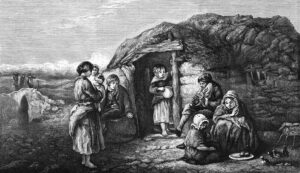
An Irish peasant cabin.
circa 1840
In the 1970s, Michael Beames noted that definition of cottier in Ireland (c. 1700–1850) was a person who rented a simple cabin and between one and one and a half acres of land, upon which to grow potatoes, oats, and possibly flax. The ground was held on a year-to-year basis and rent was often paid in labour. Usually, the land available to the cottier class was land that the owners considered unprofitable for any other use. The cottier existed at subsistence level because of high rents and the competition for land and labour. The more prosperous cottier worked for his landlord and received cash after rent and other expenses were deducted. There was no incentive to improve a land holding, as any such improvement usually prompted a rent increase.
While not wanting to risk further wrath from cottage/cotter terminology and its long connection to colonialism and exploitation, it is worth considering the documentary evidence from the mid-nineteenth century ordnance survey maps. A major growth in population in the early nineteenth century was brought to an abrupt halt in Ireland by the potato blight famine. The first edition ordnance survey maps and the 1841 census of Ireland (what remains of it) indicate that about 40% of the population lived in one room dwellings, that were described as “cabins”. The census classifies houses as follows: “Fourth Class comprising all Mud cabins having only one room; the third, a better description of cottage, still built of mud, but varying from two to four rooms with windows; the second, a good farm-house or, in towns, a house in a small street having from five to nine rooms with windows; and the first, all houses a better description than the preceding ones.” By the 1901 census, this type of housing was almost extinct with just over 0.5% of the overall population listed as living in fourth class type of housing in the census that year. “Their clay or stone walls gathered from the earth on the spot, their timbers dug from the bogs, their thatch harvested from the fields.” (See
https://skibbheritage.com/famine-era-housing-of-the-poor/ ).
The work of the Land Commission after the famine period, in providing housing for the landless, and dividing up the landlord estates to tenant farmers is still unfortunately not available to us in the same way as the surviving censuses and maps though we can hope some of the records will finally become available over the next decade. What we do know is “cottage” life wasn’t in any way idyllic.
Seanchaí Editions, a team of website and content creators based in Connemara, describe this well: “Many wouldn’t have shared the romantic, contemporary idea of the “thatched cottage”: humans and animals had to live in one room, in a damp, smoky and poorly lit setting. Certainly the poor woman who had to deal with six or seven children, with a baby to breastfeed, a pig, a sheep and several chickens scratching about and the pot on the stove with the ubiquitous potatoes ready for the husband coming home from work would have bitterly laughed at Hollywood depiction of this kind of house”.
Very few one-room houses now exist. They are not what make up our contemporary idea of a “cottage”. For almost any location in Ireland, by viewing the
online versions of the historical ordnance survey maps, you can see recorded the disappearance of these cabins and the rearrangement of landholdings in the latter half of the nineteenth century. Use your eircode to search the history of the buildings around you.
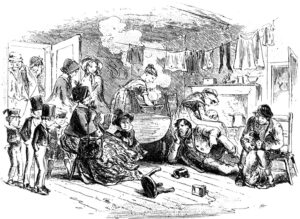
This is in stark contrast to the treatment of “cottages” in English language literature, beautifully summarised by Catherine Peck in the abstract of her 2023 PhD on
The Country Cottage in Nineteenth-Century Literature. “The foundational qualities of the cottage image are established in the medieval settings of children’s fairy tales by the Brothers Grimm and George MacDonald, as a pre-industrial rural retreat and a feminised domestic space. In the 19th century, Charles Dickens uses various cottage settings and qualities in David Copperfield and Bleak House to construct the ideal domestic home. George Eliot’s portrayal is of nuanced social dynamics among nineteenth-century isolated cottage communities in Adam Bede and Silas Marner. Thomas Hardy addresses the impacts of modernisation on these traditional, yet outdated, communities in The Return of the Native and The Mayor of Casterbridge”. Catherine also illustrates the pictorial “romantic idea” of cottages in her PhD along with the overcrowded conditions in urban settings.
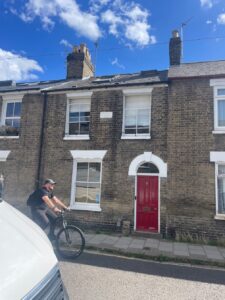
From the eighteenth century onwards, the development of industry also led to the development of housing for specific types of industrialised worker such as weavers’ cottages with large windows for lights, and terraces of miners’ cottages. The living conditions in these buildings were famously illustrated by Engels as poor quality dwellings in his 1845 work
The Condition of the Working Class in England. We still have areas of “cottage” dwellings in most Irish cities. There is also the planned town of Portlaw in Waterford, with its carefully constructed terraces of houses for millworkers. I took a photograph of a terraced two storey “cottage” in Cambridge close to the railway station only last week – Ebenezer Cottage 1871 according to its foundation stone. What we now think of as “Irish cottages” are not the pre-famine cabins, but buildings often created by employers, or as intermediate landlord habitation (small farmhouses), built through the actions of the Land Commission and local authorities (Labourer’s or Parnell or council cottages) or by estate owners to house their workers.
Our idyll of the peaceful rural country cottage was powerfully propagandised by English landscape painters such as Gainsborough, Turner and Constable. As Steve Middlehurst points out in his blog “
The Myth of the Countryside Idyll“, “the market for 19th century painters was the aristocratic landowners and their new money counterparts, families whose wealth was derived from the industrial revolution” while “the farm labourer riots of the 1830’s, caused by what Cobbett called “unsatisfied hunger” occurred in a parallel reality to these paintings”. Middlehurst also highlights the way landscape photography continued the inaccurate romantic trend, with a few honourable documentary exceptions such as Peter Henry Emerson in East Anglia. The two world wars promoted rural idylls in recruitment posters as “what we are fighting for”.
After wars of Irish independence and the civil war clarified who we were fighting for, we can remain indebted to the Swedish ethnographer Åke Campbell for lighting up interest in “The Irish Peasant House” in the 1930s, as this work was described by E. Estyn Evans in the Ulster Journal of Archaeology in 1940. Campbell and Kevin Danaher recorded many house types now almost vanished. Yet in Sweden too, what began as remarkable works of recording have become used to promote an idea of a rural idyll seized on during the emergence of new property users, as part of the conflicts and processes of exclusion and gentrification. Swedish torps now act as second homes – “summertime idylls for overworked town dwellers”
[Lagerqvist, Maja, 2014],
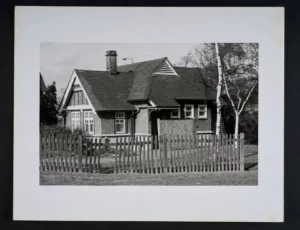
As we speed through the 20th century, we cannot ignore a byway that probably also denigrated the use of the term “cottage” amongst Irish people in the days before Senator David Norris gave a voice to homosexuality.
Cottaging, as a gay slang term, originated in the United Kingdom, where
detached urban public toilets located in public parks were often designed to have a “faux-cottage” appearance despite their purpose, and were used as meetup points for sexual encounters.
But in the main, most people will have encountered “the Irish cottage” through searches for holiday rental accommodation.
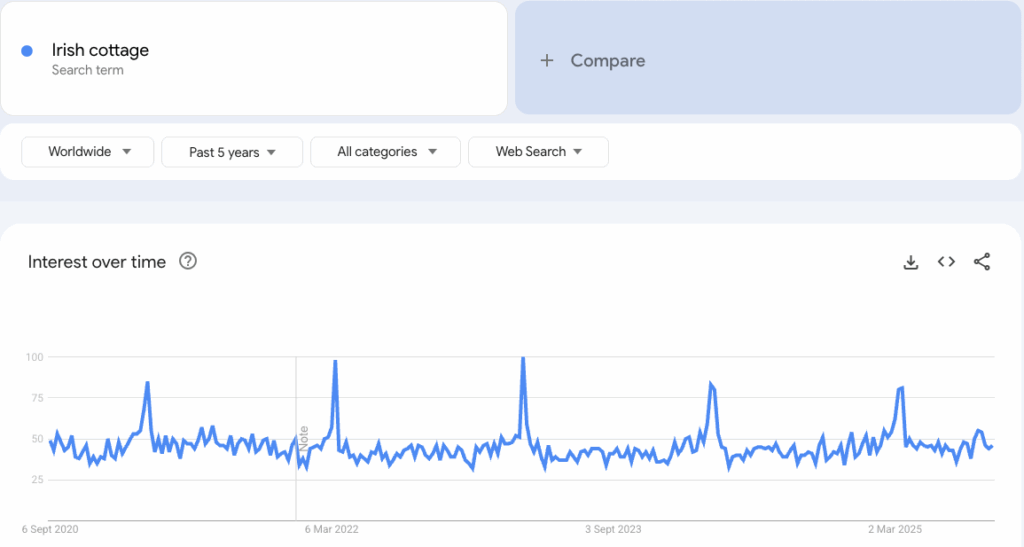
Using Google Trends, since 2004 the peak searches for the term “Irish Cottage” are in the holiday months of July and August, with smaller peaks around St Patrick’s Day.
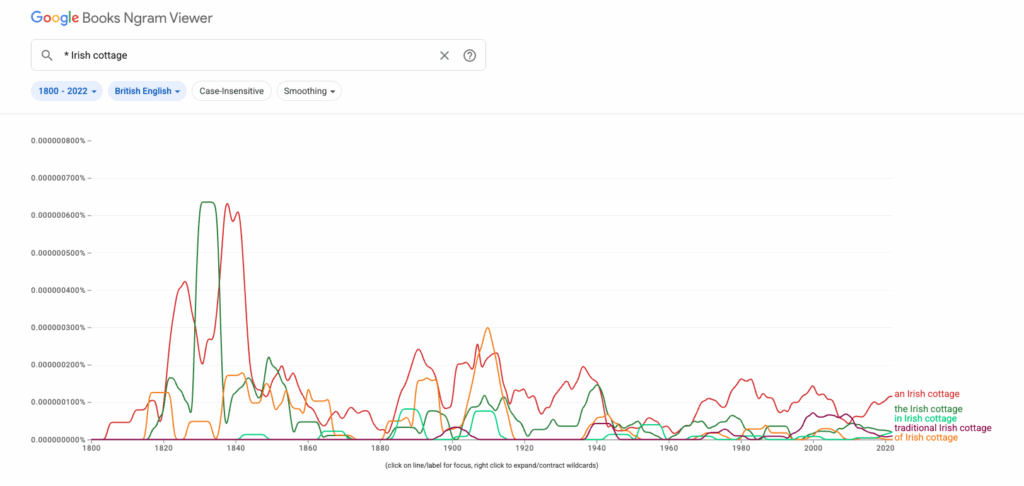
Google Ngram looks for terms used in books and its accuracy is questionable since it depends which books have been indexed. It shows peaks for “Irish cottage” between 1830 and 1845, and again from 1880 to 1940, slumping away in the modernist 1950s and 1960s but creeping back as second homes become economically feasible from the 1980s.
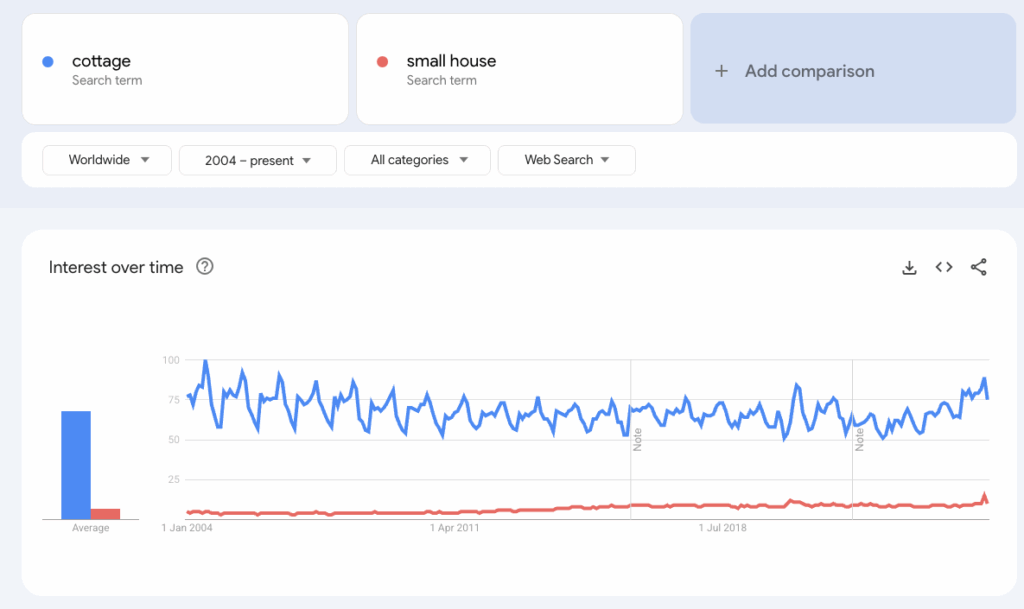
The term cottage alone (not specifically Irish cottage) sees a lot more book and search traffic, with Ngram searches for “the cottage” shooting up after 2000 to a current level of 0.00045%, which is over one hundred times as many as for “small house” at 0.000035%.
A new popular search term,
Cottagecore, appeared in 2021, describing a way of life around escapist outdoor slow country house living idealised on social media. Cottageology isn’t even making an appearance yet in digital search terms, but we can live in hope, and membership of the Cottageology facebook group has now reached an active 21,000 users. The vast majority are people from Ireland (81%) or Irish emigrants living in the US, UK, Australia, Canada and Europe.
I feel that the choice to keep the name “Cottageology” has been justified by its “Googlejuice” in terms of helping those able to repair and inhabit our small old Irish houses get in contact with sources of advice and funding. Cottage has become a shorthand for “small house” in a popular culture that mainly uses American and Britain for its cultural references. But I also worry that some are coming to us more as people looking for second homes or an idyllic way of life. Lime rendering and digging French drains may come as a bit of a shock to them.
A list of features common to these small old Irish houses was compiled by Fidelma Mullane for the
Townlands Survey in Northern Ireland 1996-7 and could provide a little common ground for agreement. The buildings we are talking about are:
- An elongated rectangular plan of informal layout
- A typical depth of six metres or less
- Have mass load-bearing walls of stone or mud
- Hearths and chimneys are located along the linear axis of the plan with chimney located on the ridge line
- Entrance door on the long side into a kitchen
- Doors and windows on the long sides
- Linear house form, extended along its length, or by addition of a second storey
- Lack of rigid symmetry with regard to doors and windows, especially on back walls
If Mullane’s points could be held in the mind by planning officers working with new inhabitants on extension plans, and those administering the Vacant Property Refurbishment grants, we would all benefit.
Imogen Bertin September 2025